
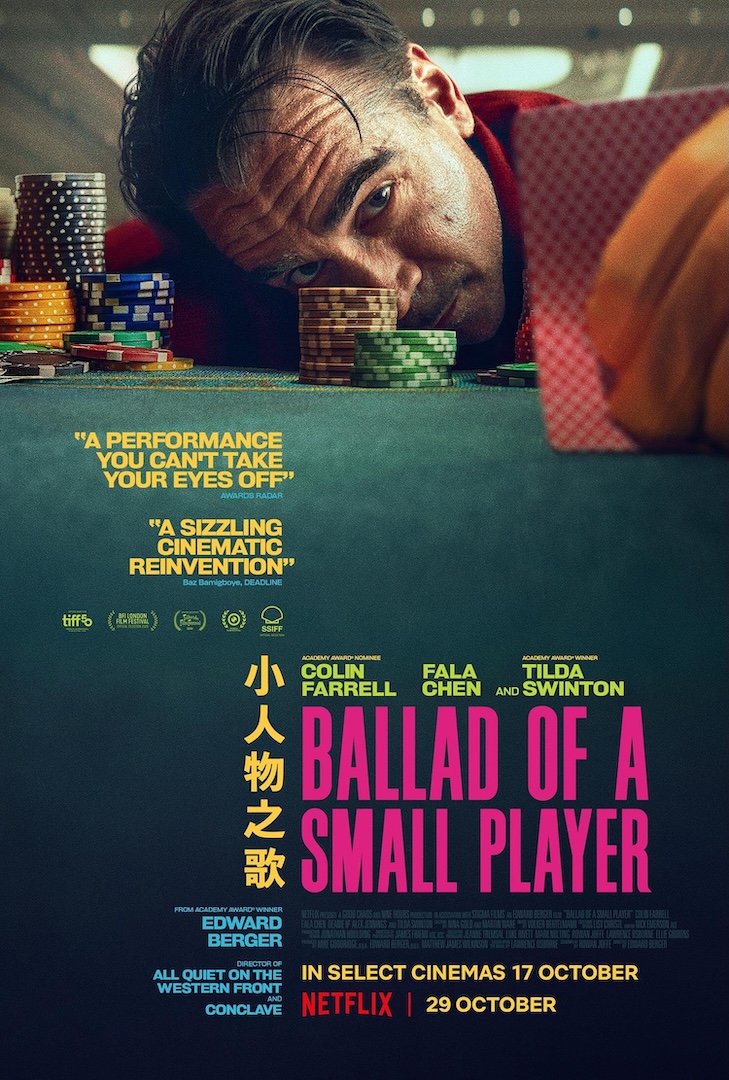
GENERAL INFORMATION
Submitted by :
ADU (Germany)
Country of origin :
United Kingdom, Germany
Release date :
29.10.2025 | Netflix (Watch online)
Type :
Feature film
Director :
Edward Berger
IMDb :
Synopsis :
Lord Doyle is laying low in Macau spending his days and nights on the casino floors, drinking heavily and gambling what little money he has left. Struggling to keep up with his fast-rising debts, he is offered a lifeline by the mysterious Dao Ming, a casino employee with secrets of her own. However, in hot pursuit is Cynthia Blithe a private investigator ready to confront Doyle with what he is running from. As Doyle tries to climb to salvation, the confines of reality start to close in.
ADs Team :
1st AD : Benedict Hoermann (ADU, ADG)
Key 2nd AD : Alex Gavigan (ADG)
Crowd 2nd AD, Key Floor 2nd AD : Valerie Adamer (ADU)
TRAILER
BEHIND THE SCENES
MISCELLANEOUS INFORMATION
Duration of the shooting :
Main Unit : 42 days (33d in Macau, China, 9d in Hong Kong, China), Pre-shoot days : 3.
Location of the shooting :
China (Macau, Hong Kong)
AD notes :
A large part of the film takes place in casinos and high‑end hotels in Macau – the biggest gambling city in the world, with a turnover roughly three times higher than Las Vegas. For the casinos, our shoot was a nuisance at best: their high‑rollers make more in a day than our film cost, and our story is hardly an advertisement for the industry. As a result, we had extremely limited, unstable access to casino floors, lobbies and public spaces. Permissions, rules and playable areas could change daily. Navigating the bureaucracy is already a challenge; doing it in Macau, under local gambling authority and security, takes it to another level.
From the crowd side, that meant constantly **re‑scaling** what was possible: a “full casino floor” on the page might, on the day, become a narrow strip between live tables. Our background plans had to be modular, with waves of extras that could be redeployed within minutes as zones opened or closed. Many “extras” were in fact real dealers, pit bosses, security and other staff, with their own working rules and hierarchies, which meant every position was a three‑way negotiation between casting, casino operations and us.
On top of that, every casino scene required our own tables, chips and cash to be fully registered and counted. Every chip and note was inventoried for every table and often every player. When we burned fake money, every bill was counted in front of the police before and after each take. Even locations that looked simple on paper – like the houseboat set out on the ocean – became logistical puzzles of tides, weather, access and crew movement. All of this had to be managed while still delivering precise, performance‑driven work for Edward.
The biggest take‑away is how absolutely true “you’re only as good as your team and your systems” becomes in a place like Macau.
Every day threw up situations none of us had seen before, even after decades in the job. Originally, Benedict was asked to work only with local ADs and not bring his regular team; he pushed back hard and nearly turned down the project until he could bring his two key ADs. Looking back, that decision probably saved the film – and certainly saved us.
On the crowd side, the three of us at the core (1st, Key 2nd, Crowd 2nd) know each other extremely well, which was priceless. Many of the other ADs around us were less experienced, and that actually made our small core team even more important: we could absorb pressure, keep the tone, and quietly stabilise things when the environment or the bureaucracy spun out. My personal rule after this show is simple: I won’t go into a setup like this again without my key ADs and real local partners. If those pieces aren’t there, I’d rather not take the job.
For us, *Ballad of a Small Player* was probably the most complicated and demanding project we’ve done – which is ironic, given that some of us came straight from *All Quiet on the Western Front*. That film was huge in scale, but *Ballad* often felt like a daily battle just to gain access to the locations we needed. We shot on casino floors in the middle of the night whenever we were briefly allowed in, grabbed plates on the fly, and finished some sequences on a virtual stage because physical access was so limited.
Casinos are not sets, they’re ecosystems. Our “crowd” often included real dealers, croupiers, security and staff alongside classic extras. Every table, chip and bill was logged; high‑roller suites could be confirmed only 24 hours in advance because a real VIP might arrive. To handle that, we had to dive deep into the world: research, long talks with advisors from the gambling industry and from Macau. A lot of what we learned – about money flows, psychology, architecture – was shocking but fascinating, and it fed directly into how we staged background so that it felt observed rather than clichéd.
If there’s one thing we’d pass on to colleagues, it’s that **crowd is infrastructure, not decoration**. On a film like this, the background *is* the atmosphere and the moral universe. It deserves to be planned as early and as seriously as camera, VFX and locations – especially when you’re stepping into someone else’s living, breathing ecosystem.